### Autonomous Space craft in the 1960s
In June 1964, when John Mc...
**John McCarthy (1927–2011)** was one of the founders of artificial...
"computer controlled" as opposed to fixed, hardwired sequencing and...
John McCarthy had coined the term “Artificial Intelligence” just 9 ...
In 1963 NASA commissioned General Electric to study a Mars lander a...
### Public interest in Martian life
When McCarthy wrote this mem...
McCarthy is pointing out that many “experiments” are really applica...
McCarthy observes that if the Beagle operates for a full year, earl...
In June 1964 these targets were ambitious yet within the realm of a...
McCarthy recommends that the Beagle computer avoid mechanical secon...
McCarthy requires that the Beagle computer survive errors in indivi...
McCarthy’s proposed software structure is a remarkably accurate blu...

STANFORD
ARTIFICIAL
INTELLIGEkCE
PROJECT
Memo
No.
14
June
15,
1964
i
COMPUTER
CONTROL
OF
A
MACHINE
FOR
EXPLORING
MARS
by John McCarthy
Computer Science
Division
Stanford
University
Abstract:
Landing a 5000 pound package on Mars
that
would
spend a
year
looking
for
life
and making
other
measurem~nts
has
been proposed.
We
be+ieve
that
this
machine should be a
stored
program computer
with
sense
and motor
organs,
and
that
the
machine
should
be mobile.
We
discuss
the
following
points:
1.
Advantages
of
a computer
controlled
system.
2.
What
the
computer
should
be
like.
3.
What
we
can
feasibly
program
the
machine
to
do
given
the
present
state
of
work on
artificial
intelligence.
4.
A
plan
for
carrying
out
research
in
computer
controlled
experiments
that
will
make
the
Mars
machine as
effective
as
possible.
The
preparation
of
this
memo
has
benefited
from
discussion
with
E
.•
Fredkin,
J.
Lederberg and
M.
L.
Minsky.
The
research
reported
here
was
supported
in
part
by
the
Advanced Research
Projects
Agency
of
the
Office
of
the
Secretary
of
Defense (SD-183)

COMPUTER
CONTROL
OF
A
MACHINE
FOR
EXPLORING
MARS
by
John
McCarthy
Comp~ter
Science
Division
Stanfor.}
IJni
vers
i
ty
In
1969
or
1971
we
can
land
5000 pounds on Mars. The machine
we
land
can
have
300
watts
of
power,
can
communicate
from
10,000
to
100,000
bits
per
second
back
to
earth
according
to
the
distance
between
earth
and
Mars. The machine shoul,.l
be
able
to
operate
for
a
year.
These
facts
',Jere
taken
from a
Gp.n:,~ral
Electric
study
called
Beagle
after
the
ship
that
took
Darwin
around
the
world.
The
Beagle
study
does
not
discuss
the
possibility
of
making
the
machine
mobile,
but
we
believe
this
can and
should
be
done
even
if
the
power
limitation
makes
it
go
very
sluwly.
We
shall
f'olltjw
G.
E.
's
lead
and
call
the
machine
the
Beagle.
The
Beagle
should
obl:.ain
as
much
Llformation
as
it
can
about
Mars
and
radio
it
back
to
earth.
Naturally,
the
most
interesting
question
is
whether
there
is
life
on Mars and
if
so
what
it
is
like.
Therefore,
we
can
set
forth
three
goals.
1.
To
carry
ou-'-
as
thorougi1 a
search
for
life
as
possible,
i.e.,
to
maximiz.e
the
probability
that
if
life
exists
on
Mars,
Beagle
will
find
it.
2.
If
life
exists
to
find
out
as
much
as
possible
about
its
chemistry,
physiology,
ani
ecologya
Chemistry
will
be
emphasized
because
the
same means
that
de+.Iect
life
may
also
be
Ilsed
to
study
its
chemistry.
3.
To
find
out
anything
about
the
environment
of
Mars
that
will
help
future
exploration,
especially
mannej
expL)ration.
Why
Computer
Control
ot
the
Beagle:
Up
to
now
space
r1·~.;bes
have
consisteci
.)1'
a
collection
of
separate
experiments
sharing
pr:='pulsion power
supply
and
telemetering.
We
believe
that
Beagle
will
be
much
more
effective
if
it
is
a
computer
with
sense
organs
and
mnt.c'r
organs
and
the
experiments
are
represented
by
,~omputer
programs
€:t.,;b
of
which
uses
the
sense
and
motor
organs
in
a
co-or1inated
way.
Beagle
differs
from
previous
space
experiments
in
a nurriber
of
ways
that
:lre
relevant
to
this
preference.
1.
A
large
numbe
r
of
sense
and motor ·.)rgans
can
'be
included
in
a 5000 pound machine.
2.
Many
of
the
experiments
(~an
use
common
facilities
of
manipulation,
picture
recognition,
etc.

30
If
Beagle
works
for
a
year
the
results
of
the
early
experiments
will
make
changes
desirable
in
later
ones~
These
needs
of
the
Beagle
mission
can
best
be
met
by
a computer
controlled
system.
A
brief
statement
of
the
reasons
follows:
1.
The
control
circuitry
of
each
sensory
or
motor
device
can
be
reduced
to
a
minimum
if
the
whole
system
is
computer
controlled.
2.
The
strategy
of
each
experiment
can
be
chosen
freely
by
writing
suitable
programs even
after
the
hardware
decisions
have
been
made.
3·
New
programs
can
be
written
and
transmitted
from
the
earth
even
after
Beagle
is
on Mars.
The
Computer and
Its
Programming:
In
this
section
we
shall
discuss
the
features
that
the
Beagle
computer
should
have.
1.
It
should
be
light,
compact,
fast,
have
a
large
memory, and
be
reliable.
We
shall
not
discuss
how
these
features
can
be
achieved
in
this
paper,
but
many
companies
are
working on
the
problems
involved,
and
we
are
quite
sure
a
suitable
computer
will
be
available.*
Suit-
able
parameters
might
be
1.1
weight
- 100
lbs.
1.2
volume - 2
cu.
feet.
1.3
memory
cycle
1
~
sec
- add
instruction
2
~
sec
-
floating
multiply
- 10
~
sec.
1.4
power consumption - 40
watts.
1.5
memory
130,144
-
48
bit
words.
If
these
goals
are
too
hard
to
meet,
some
compromises
are
possible,
but
even
higher
performance
might
be
helpful.
2.
If
possible,
the
system
should
nat
use
mechanical
secondary
storage,
e.g.
tapes
or
drums. They
make
reliability
difficult.
3. The
system
must be
able
to
recover
from programming
errors
in
programs
that
carry
out
particular
experiments.
Otherwise,
it
will
be
impossible
to
allow
the
wide
variety
of
programs
necessary
to
make
use
of
the
flexibility
of
a computer
based
system.
In
particular,
it
would
be
difficult
to
allow
the
revision
of
programs from
the
earth
on
the
basis
of
preliminary
experimental
results
if
an
error
in
such
a
revision
could
cripple
the
whole machine.
* I
don't
want
to
suggest
that
reliability
will
come
automatically,
only
that
I
don't
have
anything
important
to
say
about
it.
2

The
ability
to
recover
from progranmling
errors
can
be
achieved
by
the
same
devices
as
one
beginning
to
be
used
to
make
time-sharing
monitor
systems
proof
against
user
errors.
The
necessary
features
are
avail-
able
on
the
Digital
Equipment PDP-l and PDP-6
computers,
on
the
IBM
360
computer and
partially
on
the
IBM
7090
and
7030
computerso
In
fact,
the
Beagle
computer
should
be
operated
with
a
time-sharing
system,
although
the
Beagle
monitor
must
differ
substantially
from
time-sharing
systmes
oriented
towards
computation
centers.
The
important
features
of
time-sharing
systems
are
the
following:
1.
The
system
has
a
user
mode
and an
executive
mode.
When
in
user
mode
the
use
of
input-output
instructions
is
inhibited
and
attempts
to
change
memory
outside
an
area
reserved
to
a
particular
program
leads
to
interrupts
to
the
executive
program.
2.
A
clock
leads
to
an
interrupt
of
the
executive
every
so
often
anyway 0
(Say,
every
millisecond).
The
executive
then
decides
what
program sho'.lld
be
executed
next
for
a quantum
of
time
..
3.
Input
or
output
devices
generate
interrupts
to
an
appropriate
part
of
the
executive
program wnenever
input
becomes
available
or
an
output
device
is
ready
for
more.
The
core
of
the
executive
prograrr~
niust
be
absolutely
debugged,
but
protection
can
be
provided
against
erl"'ors
in
large
parts
of
the
executive
(eogo,
the
programs "that
handle
input-output
devices)
by
allowing
earth
generated
interrupts
to
a
part
of
the
executive
that
can
be
instructed
to
make
changes
in
the
rest
of
it.
We
envisage
the
program
to
be
divided
into
four
parts.
10
The
time-sharing
executive
-
divides
the
time
among
the
application
programs.
2.
Housekeeping
programs.
Handle communication
with
earth,
temperature
control
management
of
the
energy
and
supply,
control
of
the
motion
of
the
machine~
3. Programs
for
operating
deviceso
Used
as
subroutines
by
the
pro-
grams
that
run
experiments.
Normally
contain
checks
to
make
sure
the
devices
are
not
damaged.
4. Programs
for
running
experiments.
These
are
written
under
the
supervision
of
the
experts
in
the
field
in
which
the
experiment
is
performed.
The
time-sharing
system
permits
them
to
be
wri.tten
inde-
pendently
of
each
other.
Mobility:
'l'he
effectiveness
of
the
Beagle
will
be
greatly
enhanced
by
mobility.
There
are
two
difficultieso
First,
an
average
power
of
250
watts
will
not
3

move
a 5000
lb.
vehicle
very
fast,
and
not
all
the
power
is
available
for
that
purposeo Second,
the
motion
cannot
be
directly
controlled
from
the
earth
because
the
response
delay
varies
from a
little
over
six
minutes
to
almost
25
minutes.
The
first
difficulty
can
be overcome
by
accepting
very
slow
progress
(e.g.,
10
cm/sec
to
100
cm/sec
depending
on
terrain)
at
times
when
the
experiments
and
information
transmission
require
very
little
energy_
The
second
problem
cust
be
solved
by
developing
computer
programs
capable
of
steering
the
vehicle
past
obstacles
over
different
terrains.
Mobility
is
important
for
the
following
reasons:
1.
Beagle
might
land
in
an
unsuitable
place,
e.g.
on
bare
rock
or
in
a
ditch.
2.
Beagle
should
be
able
to
look
for
high
points
from which
to
transmit
pictures
of
the
landscapeo
3.
Features
that
looked
interesting
in
pictures
could
be
examined
at
close
range.
4.
The
search
for
life
will
be
more
effective
if
Beagle
can
go
look
for
ito
Artificial
Intelligence:
Research
labelled
artificial
intelligence
is
aimed
at
making
computers
perform
tasks
that
require
intelligence
when
performed
by
humans. The
exploration
of
Mars
involves
many
such
tasks.
If
the
artificial
intelligence
problem
were
completely
solved
we
could
expect
to
send
a computer
to
Mars
with
no
control
from
earth
and
have
it
send
back
all
the
information
that
could
be
acquired
by
a
large
manned
expedition.
In
fact,
it
is
very
unlikely
that
results
comparable
to
manned
exploration
will
be
achievable
by
computer
controlled
machines
within
the
next
twenty
years.
However, many
of
the
subsidiary
tasks
are
within
or
near
the
present
state
of
the
programming
art
especially
if
the
machine
can
be
instructed
from
the
earth
if
it
gets
stuck.
Some
of
the
tasks
are:
1.
Controlling
the
telemetering
so
as
to
submit
information
at
the
maximum
rate
compatible
with
the
orientation
of
Mars and
the
distance
from Mars
to
earth.
Information
of
lower
priority
can
be
saved
for
later
transmission
at
times
when
high
priority
messages
have
to
be
sent.
2.
Compression
of
information.
Sending
only
deviations
of
an
instrument
reading
from
its
expected
value
based
on
previous
readings.
Picture
compression
is
more
difficult
but
some
results
have
been
achieved.
30
Picture
recognition.
In
various
forms,
picture
recognition
is
required
for
a number
of
Beagle's
tasks.
Some
of
these
are:
4

;.1
Recognizing
types
of
terrain
and
obstacles
so
that
Beagle
can
obey
orders
to
move.
;02
Recognizing
the
lands
of
materials
it
has
been
ordered
to
collect
for
analysis.
;.;
Co-ordinating
the
devices
that
pick
up samples and
subject
them
to
analysis.
4. Motor
co-ordination,
co-ordination
of
the
"hands"
and
wheels
and
"legs".
5.
Other
experimental
strategies.
The
assumption
that
the
computer can
be
programmed
to
achieve
the
above
goals
relies
heavily
on
the
ability
to
reprogram
it
from
the
earth
when
unexpected
conditions
are
encountered.
We
do
not
expect
the
state
of
work
in
artificial
intelligence
by
1970
to
make
the
following
feasible.
1.
To
put
in
the
program
our
concepts
of
what
is
interesting.
2.
To
define
life
well
enough so
that
the
machine would
recognize
any form
of
it.
;.
To
make
the
program
adaptable
to
any
terrain
without
further
instruction.
e.g.,
swamps
or
mountains.
Projects:
The
problem
of
making good
use
of
a 5000 pound
payload
is
very
difficult.
A number
cf
investigations
should
be
started
right
away
if
the
Saturn
V
rocket
is
to
be
used
when
it
becoffies
available
0
Some
of
these
projects
are:
1.
Design
of
a
suitable
computer.
We
assume
that
the
work on
small,
light,
reliable
and
fast
computers
with
low power
consumptions
is
pro-
ceeding.
We
are
less
confident
that
the
computer compani€s
will
come
up
with
system
designs
suitable
for
the
sophisticated
programming
that
would
be
required.
The
Stanford
Computer
Science
Division
would
be
interested
in
helping
with
the
order
code,
input-out
structure,
and
system
program
design
for
such a computer.
2.
Artificial
Intelligence.
Anything
that
can
be
learned
about
how
to
make
machines behave
intelligently
will
eventually
be
of
use
in
unmanned
planetary
exploration.
The
most
critical
problem
for
Beagle,
however,
is
the
visual
pattern
recognition
necessary
for
selecting
and
picking
U.p
samples and
for
steering
a
vehicle
past
obstacles
to
a
goal.
The more
we
can
achieve
in
general
purpose
manipulation
the
less
it
is
necessary
to
rely
on Rube Goldberg
contraptions
for
raising
antennas,
picking
up
samples,
righting
the
machine
after
landing,
etc.
5

•
3. A
~ample
collector.
The
mechanical
engineering
of
a
device
for
picking
up and
breaking
and
crushing
samples
should
be
undertaken
soon.
4.
A
vehicle.
The low power
that
is
likely
to
be
available
calls
for
a
special
vehicle
design.
For
example, a
crab
that
uses
the
same
organs
for
mobility
and
for
picking
up
things
may
be
appropriate.
We
believe
that
work aimed
at
a
prototype
Beagle
that
can
be
tried
out
on
earth
should
be
started
as
soon
as
possible.
We
are
eager
to
help
with
this.
6
**John McCarthy (1927–2011)** was one of the founders of artificial intelligence. He coined the term *“artificial intelligence”* in the mid-1950s and helped launch the Dartmouth summer project that effectively started the field. He later created **Lisp** (late 1950s).
He spent part of his early career at **MIT**, then went on to build Stanford’s AI effort, and from 1965–1980 he directed what became the **Stanford Artificial Intelligence Laboratory (SAIL)**.
McCarthy received the **Turing Award** in **1971** for foundational contributions to the field. This **1964** memo reflects a career-long ambition to formalize common sense and logical reasoning within machines, aimed at solving complex real-world problems like autonomous planetary exploration.
### Public interest in Martian life
When McCarthy wrote this memo, the notion that Mars might be home to intelligent life—or even thriving “colonies” of canal-building Martians—had only recently faded from mainstream belief. Widely reported newspaper headlines (e.g., New York Times, 1911: “Martians Build Two Immense Canals in Two Years”) and popular culture had fueled decades of public excitement about Martian canals and civilizations. The idea lingered into the early 1960s, even as most astronomers grew skeptical. Just thirteen months later, NASA’s Mariner 4 flyby (July 1965) sent back the first close-up photos, revealing a cratered, dry world and ending the canal myth forever.

*New York Times cover from 1911 announcing the construction of canals on Mars*
John McCarthy had coined the term “Artificial Intelligence” just 9 years earlier (1955) when proposing the Dartmouth AI project.
"computer controlled" as opposed to fixed, hardwired sequencing and simple relay logic.
McCarthy requires that the Beagle computer survive errors in individual experiment programs without bricking the whole machine. Without this protection, the flexibility of running many different programs and uploading revisions from Earth after early results arrive would be too dangerous.
He draws directly on techniques then emerging in time-sharing operating systems. These systems introduced mechanisms such as user mode versus executive mode, memory protection, and timed interrupts to isolate user programs and prevent one faulty program from crashing the whole computer. In 1964 such safeguards were brand new; most computers still ran unprotected batch jobs where a single error could stop everything. McCarthy, who had proposed time-sharing concepts as early as 1959, saw that the same mechanisms could enable safe, adaptive programming on a distant spacecraft. This insight was far from obvious at the time.
McCarthy is pointing out that many “experiments” are really applications on top of the same core capabilities: sensing, manipulation, and vision. That framing mirrors early time-sharing and OS design: build shared system services (I/O, scheduling, device control) once, then let many programs reuse them, instead of hardwiring each experiment as a one-off.
McCarthy recommends that the Beagle computer avoid mechanical secondary storage such as magnetic tapes or drums. Moving parts are vulnerable to the extreme vibration, temperature swings, and radiation of a Mars mission and would sharply reduce overall system reliability.
In practice, several early spacecraft did fly magnetic tape recorders despite this risk. The Gemini spacecraft (1965–1966) used a tape drive to load programs into core memory. Mariner probes, the Viking landers (1976), and the Voyager spacecraft (1977) all carried digital tape recorders to store camera images and science data for later playback when Earth was not visible. These devices worked but occasionally caused problems (including mechanical wear on Voyager’s recorders decades later). True drum memory, however, was never used in any flown spacecraft computer. McCarthy’s caution proved well-founded once solid-state memory became practical in later missions.
McCarthy’s proposed software structure is a remarkably accurate blueprint for the modular operating-system architecture that would dominate computer science for decades. By separating the core “platform logic” of the machine from the specific “tasks” it performs, it anticipates several foundational principles of modern systems.
**Kernel and scheduler:** the “time-sharing executive” acts like an OS kernel scheduler, allocating CPU time across programs and ensuring critical system work (like thermal control and comms) keeps running even if an experiment program misbehaves.
**Hardware abstraction and drivers:** putting device operations into shared subroutines with built-in safety checks is an early version of device drivers and a hardware abstraction layer. The goal is to protect motors, sensors, and actuators from being damaged by buggy experiment code.
**Separation of concerns:** splitting “housekeeping” (system services) from “experiments” (applications) creates a clean boundary so domain experts can write specialized programs without also managing low-level realities like power budgets, telemetry, or mobility control.
In June 1964 these targets were ambitious yet within the realm of active research. Ground-based scientific computers like the IBM 7090 offered a 2.18 µs memory cycle, up to 32 768 words of 36-bit core memory, and add times in the same range as McCarthy’s 2 µs, but they filled entire rooms and consumed tens of kilowatts. No spacecraft had yet flown a stored-program computer at all. The Apollo Guidance Computer, then in early design, would reach flight with an 11.7 µs cycle time, only 2 048 words of erasable memory plus 36 864 words of fixed ROM, and 55 W power consumption - already considered a major engineering triumph.
McCarthy’s goals of a 1 µs cycle, 2 µs add, 10 µs floating multiply, 40 W total power, and 130 144 words of 48-bit memory (roughly 780 KB) were therefore pushing the limits of what seemed feasible for a radiation-hardened, one-year Mars mission. In practice they proved challenging to meet for the era. The Viking landers that finally reached Mars in 1976 flew dual Honeywell 24-bit computers with only 18 KB of plated-wire memory each, smaller and slower than McCarthy had hoped. The gap between laboratory performance and space-qualified hardware would narrow over the following decades.
### Autonomous Space craft in the 1960s
In June 1964, when John McCarthy wrote this memo, no autonomous vehicle had ever operated on another celestial body. All prior space probes - such as the Soviet Luna 1–3 flybys that photographed the Moon’s far side in 1959 or NASA’s Mariner 2, which flew past Venus in 1962 - were non-mobile craft equipped only with fixed, hard-wired instruments. These probes collected data during a single pass or crash landing and transmitted it back in real time or via simple recorders; they had no on-board programmability, no mobility, and no ability to navigate or adapt to terrain. Soft landings on any extraterrestrial surface had not yet been achieved anywhere (the first would be Luna 9 on the Moon in February 1966), and the concept of a rover was absent from all mission designs.
McCarthy observes that if the Beagle operates for a full year, early experimental data will naturally suggest changes to later observations. This advantage is possible only with a stored-program computer that can be reprogrammed from Earth.
This foresight was fully realized in the Voyager missions launched in 1977. The spacecraft flew pre-set trajectories. Yet ground controllers uploaded thousands of new command sequences after each flyby. Discoveries such as Io’s active volcanoes and Jupiter’s faint ring system led to completely revised imaging plans for the later encounters. Different filters, exposure times, pointing directions, and entirely new targets at Saturn, Uranus, and Neptune were used. For instance, close-up pictures of Neptune were never part of the original mission plan. New logic was uploaded to rotate the entire spacecraft slowly during exposures so that long-exposure images of the planet and its rings would remain sharp despite the spacecraft’s motion. The result was far richer scientific returns than any fixed pre-launch program could have achieved.
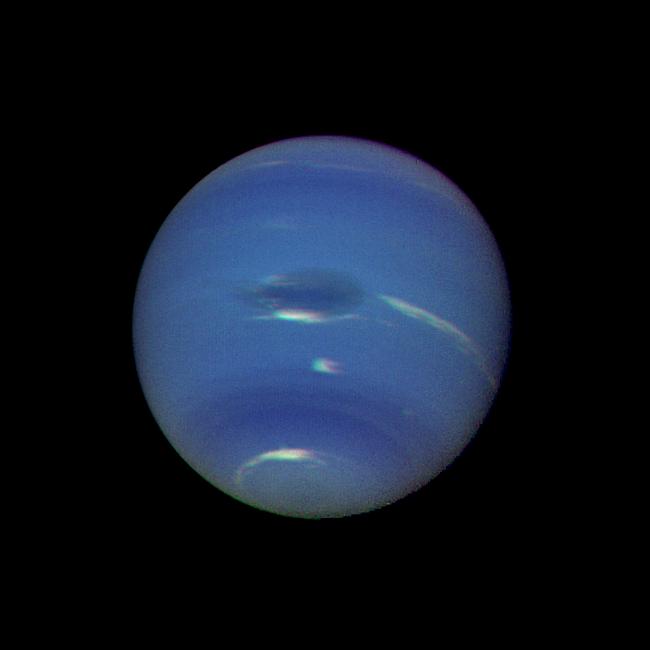
*Close picture of Neptune - only made possible by software uploaded to the Voyager probe after launch*
In 1963 NASA commissioned General Electric to study a Mars lander as part of the early Voyager program, using Saturn V rockets for a 1969 or 1971 launch. Codenamed “Beagle” (after Darwin’s ship), the study described a stationary 5,000-pound lander with 300 watts of power and a one-year lifetime. Its goal was a search for life, but it included no mobility and no on-board computer control. The projected cost exceeded $1 billion in 1964 dollars. McCarthy uses it as a technical baseline to argue that such a massive payload could and should be mobile.
The ambitious Voyager Mars program was cancelled in 1967 due to budget cuts and Apollo priorities. It was later revived and scaled down as the Viking program, which successfully landed two stationary spacecraft on Mars in 1976 - the first soft landings there - carrying life-detection experiments but without mobility or the programmable computer control McCarthy envisioned.